Even the Devil Quotes Scripture — The Original Distortion, and What Took Scripture's Place
Part 1 — The Original Distortion
"The devil can cite Scripture for his purpose." Shakespeare gives the line to Antonio in Act 1, Scene 3 of The Merchant of Venice. When the moneylender Shylock reaches for the story of Jacob in Genesis to justify charging interest, Antonio compares him to a villain with a smiling face and an apple rotten at the core. Shakespeare was not simply retelling an episode from Matthew's Gospel. But the roots of this scene — Scripture bent to private ends — lie in the temptation in the wilderness.
The original is in Matthew 4: the temptation of Jesus in the wilderness. Before beginning his public life, Jesus faces three tests from Satan in the desert.
"If you are the Son of God, throw yourself down."
— Matthew 4:6
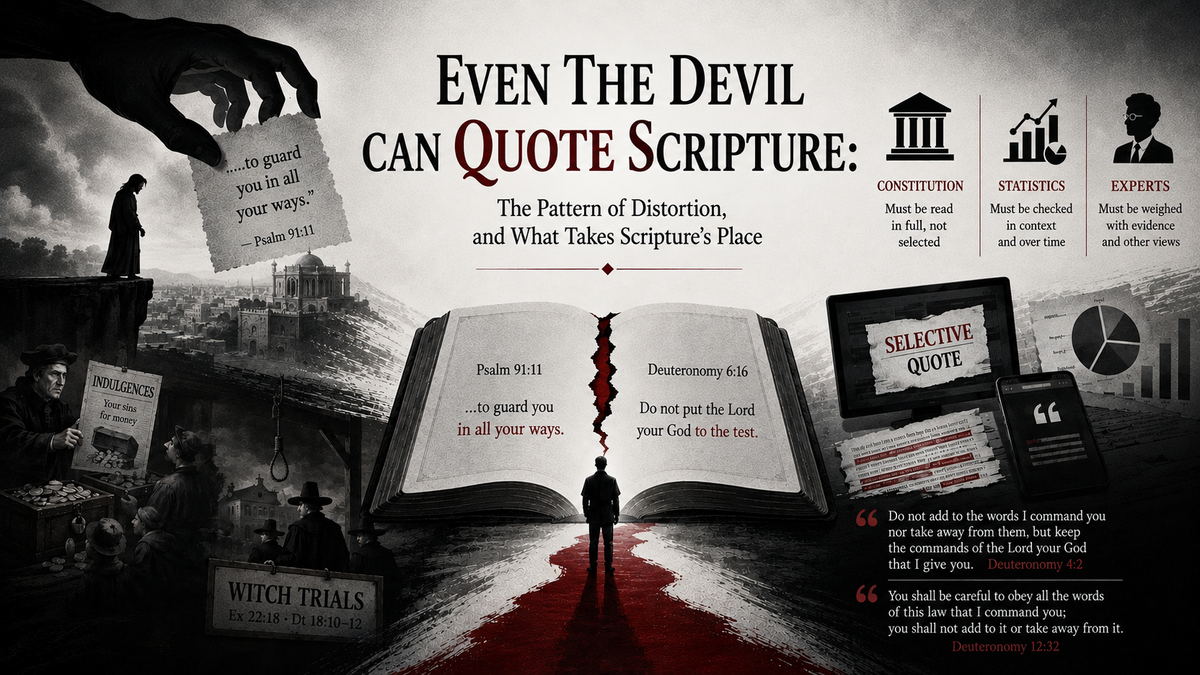
"...to guard you in all your ways."
— Psalm 91:11
Satan takes Jesus to the top of the temple in Jerusalem. "If you are the Son of God," he says, "throw yourself down" — and he backs the demand with Scripture: Psalm 91, a song from the Old Testament's book of prayers. It promises that God will send his angels to guard you, so that your foot will not strike a stone. Satan's logic runs like this: Scripture says God protects. So jump — God is bound to catch you.
But open the psalm itself and you find the words Satan left out: God guards you "in all your ways." That phrase carries the condition of the promise. God protects people as they walk the path given to them — not when they manufacture danger and demand a rescue. Satan never denied Scripture. He picked the parts he needed and dropped the parts in his way. That is how he turned a promise of protection into "so go ahead and jump." The most cunning distortion does not rewrite the text. It keeps the useful words and deletes the rest.
Jesus' response is the heart of the story. He did not say "stop quoting Scripture." He did not cast doubt on quotation itself. He answered from another book of the Old Testament, Deuteronomy 6:16: "Do not put the Lord your God to the test."
Set the two verses side by side and the trick becomes visible. The psalm promises that God guards those who trust him and walk their path. It does not say you may leap into danger to see whether he shows up. Yet Satan turned the promise into a dare: jump, and he will catch you as promised. Trusting God's protection and testing God are different things. Deuteronomy marks exactly that difference. With one verse, Jesus exposed how Satan had twisted the psalm.
The lesson is plain. The way to fight a distorted quotation is not to throw out quotation altogether. It is to ask what the words originally meant — and to read them alongside their context and the rest of the teaching.
Church history repeats the pattern. In 1517, sermons selling indulgences spread across Germany — certificates said to release the buyer from punishment for sin. The revenue was tangled up with the construction costs of St. Peter's Basilica and the debts of the Archbishop of Mainz. Johann Tetzel worked as the campaign's preacher. In Thesis 27 of his Ninety-five Theses, Martin Luther attacked the preaching that as soon as the coin rings in the chest, the soul springs out of purgatory. (Purgatory, in Catholic teaching, is where the dead are cleansed of sin before entering heaven.) Such teaching, Luther said, was a doctrine of men. His target was not Scripture. It was preaching that turned repentance and forgiveness into something money could settle. What he fought was not the Bible but a way of misreading it.
The witch trials show sacred authority pressed into the service of violence. In 1641, the Massachusetts Body of Liberties made witchcraft a capital crime and cited Exodus 22:18 and passages from Deuteronomy as its legal grounds. One Bible verse did not create the witch trials; fear, the court system, torture, and forced confessions all did their work. But one fact remains: the words of Scripture became part of the legal basis on which the state could kill. If indulgences used sacred authority to collect money, the witch trials used it to dress violence up as righteousness.
One thing must be said clearly. The lesson of this history is not "the Bible is dangerous." Neither Jesus nor Luther abandoned Scripture; both found their answer inside it. The way to guard the text is not to leave it but to read it rightly. The question to ask is not "did he quote?" but "what did he keep, what did he cut, and does it match what the words originally meant?"
And this does not happen only inside the church. It happens in modern society too. The indulgence sellers are gone, but their rhetoric survived. Today the constitution, statistics, and expert opinion are sometimes used just the way Scripture once was.
Deuteronomy 4:2
You shall not add to the word which I am commanding you, nor take away from it, that you may keep the commandments of Yahweh your God which I am commanding you.
Deuteronomy 12:32
Whatever I am commanding you, you shall be careful to do; you shall not add to nor take away from it.
Part 2 — What Took Scripture's Place
The pattern so far is simple. Satan, tempting Jesus in the wilderness, never denied Scripture. He picked the parts he needed and dropped what stood in his way. The indulgence sermons attached holy words to money and false assurance. In the witch trials, the words of Scripture became one legal basis for the state to kill. The problem was never the authority itself — it was how the authority was used. The indulgence sellers are gone. Their rhetoric survived.
In our public debates, the constitution, statistics, and expert opinion serve as key standards. These three are not, of course, the same kind of authority as Scripture. A constitution is a society's ground rules; statistics measure reality; experts must explain their evidence. But sometimes "the spirit of the constitution says," "the statistics show," and "experts agree" work not as the opening of a discussion but as the closing of one. The problem is not authority. It is treating authority as a shield.
The American economist Thomas Sowell had a word for this attitude: "the anointed" — intellectuals, journalists, and politicians who believe they alone hold the answers to fix the world. What he attacked was less whether they had evidence than how they behaved when the evidence disagreed with them. The moment you count only the sources that fit your view and refuse to look at the ones that do not, quotation stops being support for an argument and becomes a way to dodge responsibility. That temptation visits every camp.
Korea's debates are no exception. Article 119 of the Constitution is a good example. Read the text itself:
(1) The economic order of the Republic of Korea shall be based on a respect for the freedom and creative initiative of enterprises and individuals in economic affairs.
(2) The State may regulate and coordinate economic affairs in order to maintain the balanced growth and stability of the national economy, to ensure proper distribution of income, to prevent the domination of the market and the abuse of economic power and to democratize the economy through harmony among the economic agents.
Some quote only Clause 1 — "freedom and creative initiative." Others quote only Clause 2 — "democratize the economy." But read only Clause 1 and you lose Clause 2, which says the state may regulate the economy for defined purposes. Read only Clause 2 and you lose Clause 1, which makes freedom and initiative the baseline. It is the same move as dropping "in all your ways" in the wilderness. The two clauses become one article only when read together. The moment you wield a single sentence to silence the other side, you repeat exactly the selective quotation this essay criticizes.
Statistics work the same way. A rise in total employment does not mean youth jobs or working hours improved. Different numbers answer different questions — and neither side is automatically lying. Whoever cites a figure should say what period it covers, who was counted, and whether the number was adjusted for the season. Only then do you know how far the number actually speaks.
The tricks of distortion come down to five:
- Clip out only the sentence that helps you.
- Treat words spoken for one situation as a rule for all situations.
- Decide the conclusion first, then hunt for support.
- Treat "I have a source" as proof of being right.
- Shift the baseline, the period, or the way of counting so that different numbers look like the same answer.
The picking and cutting we saw in the wilderness looks perfectly familiar on today's screens.
Let one thing be clear. No camp is fully free of this temptation. Conviction exists on the left and on the right, and so does the urge to pick friendly quotations. What separates them is not how strong the conviction is, but whether they are ready to correct it when it is wrong. Can my quotation be checked against the original text and the original source? Do I leave a door open for data and opinions that cut against me? If the answer is no — whichever side gives it — that side is using Satan's method from the wilderness: keep the useful words, drop the words in the way, and refuse every request to check the original meaning. Which camp the person stands in does not matter. What matters is how they handle a quotation. The side that stops asking questions is the side that loses.
So what is the answer? "Trust nothing" is not it. Abandon the constitution because it gets quoted selectively, throw out numbers because statistics get distorted, dismiss experts because expertise gets abused — and all that remains is the louder voice. Each authority has its own form of verification instead. For the constitution, read the whole article. For statistics, check the original data and the method. For expert claims, examine the evidence and the other opinions.
Scripture also offers a model of the right attitude. In the Book of Acts, the people of Berea listened to the apostle Paul — and still searched the Scriptures daily to see whether what he said was true. They did not mock authority, but neither did they stop thinking in its presence. The attitude we need sits in the same place: quote the constitution, and read the full article; quote a statistic, and check the period and the baseline; quote an expert, and weigh the evidence and the objections.
A quotation is not a conclusion. It is where verification begins. Authority can be borrowed. Honesty cannot.
Acts 17:11
Now these were more noble-minded than those in Thessalonica, for they received the word with great eagerness, examining the Scriptures daily to see whether these things were so.
Notes
- William Shakespeare, The Merchant of Venice, Act 1, Scene 3 — Folger Shakespeare Library
- Psalm 91:11–12, Matthew 4:5–7, and Deuteronomy 6:16 compared
- Johann Tetzel — Encyclopædia Britannica, 1911 edition
- Martin Luther, The 95 Theses, esp. Theses 1, 27, 35, 36
- Witchcraft law up to the Salem witchcraft trials of 1692 — Commonwealth of Massachusetts
- Thomas Sowell, The Vision of the Anointed (New York: Basic Books, 1995) — related interview: PBS Think Tank transcript, 1995
- Constitution of the Republic of Korea, Article 119 — Korea Law Information Center
- Acts 17:11