Comprehensive Report: Early Voting Period, 9th Nationwide Local Elections
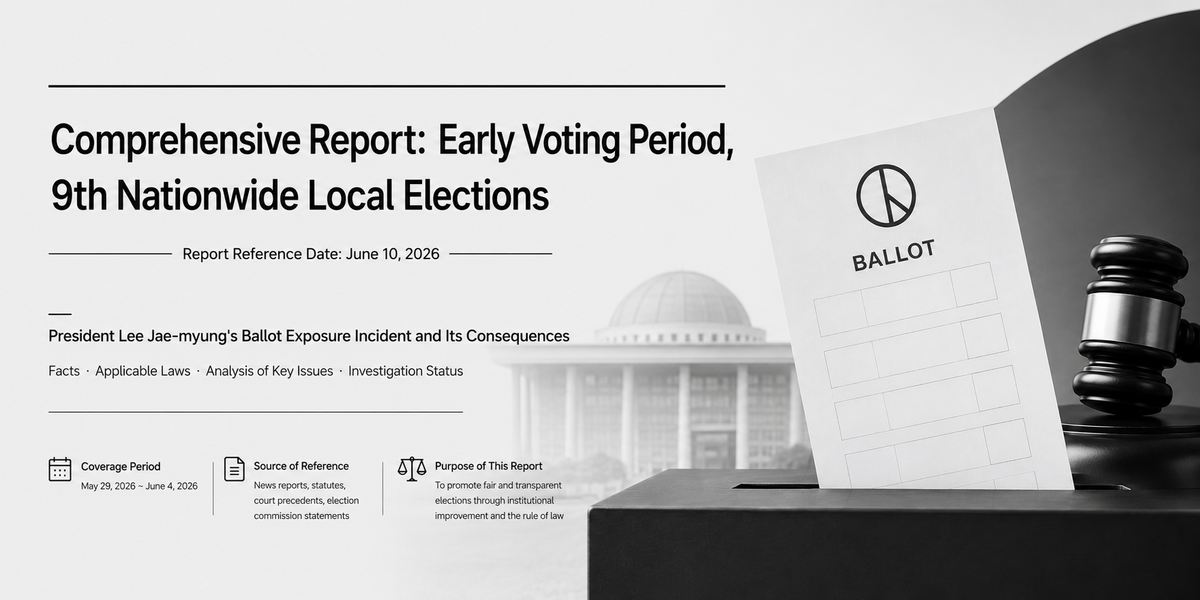
President Lee Jae-myung's Ballot Exposure Incident and Its Consequences
Report Date: June 10, 2026
Coverage Period: May 29, 2026 (Early Voting Day 1) — June 4, 2026 (Day after Election)
Sources: Major Korean news reports, Public Official Election Act (POEA), relevant case law, official NEC positions
---
Table of Contents
- Early Voting Overview
- May 29 — The Incident
- Applicable Law
- Analysis of the NEC's Valid-Ballot Ruling
- May 30 — Criminal Complaints Filed
- May 31 — Legal Experts Weigh In
- June 1 — NEC Reaffirms Ruling; Calls for Reform
- June 2 — NEC Issues Belated Warning
- June 3 — Election Day Copycat Incidents
- Investigation Status (as of June 10, 2026)
- Key Issues: Comparative Analysis
- Comprehensive Assessment
1. Early Voting Overview
Early voting for the 9th Nationwide Local Elections (June 3 Local Elections) ran for two days — Friday, May 29 through Saturday, May 30, 2026 — at polling stations across the country. The system, introduced in 2013, allows voters to cast ballots before election day at any designated station regardless of registered address. Participation has climbed with each successive election.
Final early-voting turnout reached 23.5% — 2.9 percentage points above the 20.62% recorded in the 8th Local Elections of 2022 and the highest early-voting rate in local election history since the system's introduction. By region, North Jeolla Province led at 35.1%, followed by South Jeolla and Gwangju at 34.1%, while Daegu recorded the lowest rate at 18.7%. Seoul came in at 23.8%. (MBC)
On the first day of early voting, May 29, an incident involving President Lee Jae-myung became the dominant political controversy of the final campaign stretch. (Chosun Ilbo, Korea Economic Daily)
---
2. May 29 — The Incident
2-1. The Facts
President Lee Jae-myung (이재명) and First Lady Kim Hye-kyung (김혜경) arrived at the Samcheong-dong Community Center early voting station in Seoul's Jongno District at approximately 12:20 p.m. on May 29, 2026. Their registered address is in Gyeyang-gu, Incheon; they are reported to have cast ballots in the Incheon mayoral race and the Gyeyang-eul by-election, among others. (Donga Ilbo)
After confirming his identity and entering the voting booth, President Lee stepped outside with his marked ballot in hand and questioned the presiding election official. (Donga Ilbo)
President Lee Jae-myung: "The stamp didn't come out in a full circle — only half of it printed. Is that okay? Will my ballot be voided? Come over here — it's fine."
The official responded:
Presiding Election Official: "You should not be showing me the ballot. It will not be voided. You're fine."
President Lee then re-entered the booth and completed his vote. Broadcast cameras accompanying his delegation captured the exchange; major outlets and online media reported it within hours. (Chosun Ilbo, Dailian)
2-2. Video Evidence: The Marking Was Identifiable on Camera
Multiple news outlets uploaded the footage to YouTube and blurred the marked section of the ballot. (YouTube) Pixelation is an editorial choice applied when content is visually legible and requires redaction. The fact that news organizations made this choice confirms that the marked candidate selection was readable on camera at the time of filming.
This confirmation directly undermines the NEC's ruling. The Commission held that the ballot was valid because the presiding official had not seen the marked candidate. If the camera captured the selection clearly enough to require blurring, the official standing nearby was in the same visual field — and the gap between his self-reported "I did not see it" and the objective conditions on video was never independently verified before the ruling issued. The NEC defined "disclosure" as a question of whether the marked selection was identifiable to another person. A broadcaster's decision to pixelate that very selection is at odds with the Commission's conclusion that no disclosure occurred.
2-3. Initial Positions: Presidential Office and NEC
The Presidential Office issued a public statement the same day: (Edaily)
"Stepping outside the booth with the ballot to ask a procedural question about a marking does not constitute a violation of election law."
2-4. The NEC's Same-Day Valid-Ballot Ruling
The National Election Commission issued a valid-ballot ruling the same day. (Donga Ilbo, Korea Economic Daily) It offered two grounds.
- The presiding official did not view the marked candidate on President Lee's ballot.
- Stepping momentarily outside the booth does not in itself constitute a violation of election law.
The NEC maintained that the official immediately told the President not to show the ballot, that the marking was not confirmed, and that the ballot therefore could not be deemed "publicly disclosed." (Kyunghyang Shinmun via Daum)
2-5. Opposition Demands Invalidation
People Power Party (PPP) issued a statement the same day demanding that the NEC explain its decision and void the ballot. (Chosun Ilbo, Etoday) Article 167(3) of the POEA mandates that a marked ballot that has been publicly disclosed must be invalidated; PPP argued that carrying the ballot outside the booth satisfied that requirement. Showing the ballot to an election official — an act the law expressly forbids — was the core of the violation, and the party added that no room for contrary interpretation existed.
---
3. Applicable Law
3-1. POEA Article 167 — Guarantee of Ballot Secrecy
| Provision | Text |
|---|---|
| §167(1) | The secrecy of the ballot shall be guaranteed. |
| §167(2) | No voter shall be obligated to disclose the candidate or party they voted for; no one may ask or demand such disclosure before the close of polling. |
| §167(3) | A voter may not disclose the marked ballot. Any ballot so disclosed shall be invalid. |
(MOLEG — Public Official Election Act, Art. 167)
Article 167(3) is the provision directly at issue. The text does not define "disclosure," nor does it expressly require proof of intent or actual perception by a third party.
3-2. POEA Article 179 — Grounds for Ballot Invalidity
- §179(1): Ballots not using official materials, unmarked ballots, multiple marks, illegible marks, extraneous writing, and marks made with unofficial tools shall be invalid.
- §179(4): A ballot bearing only a partial mark or a filled-in mark shall not be invalidated if use of the official marking tool is clear.
The NEC's own published guidance follows the same standard: a ballot on which the marking is incomplete but the official tool was clearly used is a valid ballot. (NEC) President Lee's query — whether a half-printed stamp mark would void his ballot — falls squarely within the category Article 179(4) treats as valid.
Critical distinction: Whether a partially marked ballot is valid under Article 179 and whether carrying that ballot outside the booth constitutes "disclosure" under Article 167(3) are legally distinct questions on separate tracks.
3-3. POEA Article 157 — Ballot Receipt and Marking Procedure
"After receiving the ballot, a voter shall enter the polling booth, mark the appropriate column, and immediately upon marking fold the ballot so that the marking is not visible to others, then deposit it in the ballot box in the presence of election observers."
This provision requires the voter to fold the ballot inside the booth — "immediately upon marking" — before exiting. President Lee stepped outside without folding. The Presidential Office and the ruling party characterized this as a "procedural inquiry," but Article 157 prescribes the sequence unambiguously: fold, then exit. A voter wishing to ask about a marking should fold first and step out, or raise the question verbally while still inside the booth.
This incident raises two distinct statutory obligations simultaneously. Article 157 imposes a procedural duty — fold the ballot inside the booth before exiting. Article 167(3) imposes a secrecy duty — do not disclose the marked ballot. The NEC's ruling addressed only Article 167(3); it did not directly confront the Article 157 question.
3-4. POEA Article 241 — Criminal Offense of Violating Ballot Secrecy
A violation of Article 167 that infringes ballot secrecy carries up to three years in prison or a fine of up to six million won. NEC commissioners, staff, and election officials who commit or enable such a violation face an elevated penalty of up to five years in prison. (MOLEG — Art. 241)
The ballot-invalidity question under Article 167(3) turns on objective disclosure. The criminal question under Article 241 requires a separate inquiry into intent and the reasonable foreseeability of disclosure. The two determinations are distinct.
3-5. Relevant Precedents
Supreme Court — Definition of "Ballot Secrecy"
The Supreme Court has interpreted "ballot secrecy" under Article 167(1) as the voter's definitive expression of choice through the act of casting a ballot — in other words, "the result of the vote." Under this reading, a breach of secrecy requires that a third party be able to identify how the voter marked their ballot. (MOLEG Case Database)
Seoul Central District Court, 2017 — "Ballot Paper" vs. "Marked Ballot"
In a case involving the photography of an unmarked ballot paper, the court held that the POEA distinguishes between a "marked ballot" (투표지) and an "unmarked ballot paper" (투표용지), and that photographing the latter fell outside the prohibition on photographing a "투표지." Because President Lee's ballot had already been marked when he exited the booth, the Article 167(3) requirement of a "marked ballot" squarely applies here. (MOLEG Case Database)
---
4. Analysis of the NEC's Valid-Ballot Ruling
4-1. The Ruling's Rationale
The NEC grounded its valid-ballot ruling in two claims. (Donga Ilbo, Etoday) First, because the presiding official did not see the marked candidate, no "disclosure" occurred. Second, stepping temporarily outside the booth differs from leaving the polling station entirely and is not itself prohibited.
4-2. Partial Legal Basis
The NEC's logic has partial support in Supreme Court precedent, which frames ballot secrecy as protection of the voter's expressed choice — who the voter actually marked. If the marked candidate was genuinely not perceived by the official or any third party, the NEC's conclusion is legally defensible. (MOLEG Case Database)
4-3. Structural Weaknesses
First, the official's statement is self-attested and unverifiable. The ruling's foundation rests entirely on the official's declaration that he did not see the marked candidate. No independent verification exists. With a president, his security detail, and delegation staff present, the official operated under significant implicit pressure not to contradict the sitting head of state. (Etoday)
Second, the official's own answer raises a contradiction. The official told President Lee, "It will not be voided. You're fine." To confirm that a partially marked ballot is valid requires assessing the condition of the marking — the very thing the official claims not to have seen. The Seominsaengmin Citizens Coalition pressed exactly this point in its complaint. (Edaily)
Third, the ruling was issued with extraordinary speed. The NEC declared the ballot valid within hours — without formal deliberation, without independent review, and before legal experts had publicly analyzed the question. The speed is inconsistent with careful legal analysis and consistent with institutional deference to executive authority.
Fourth, no published precedent establishes equal application. There is no publicly available NEC interpretation or prior ruling holding that the "the official didn't see it, therefore no disclosure" standard applies uniformly to all voters. The NEC applied a standard to the President with no documented basis for equal application to ordinary citizens. (Etoday, Yonhap)
---
5. May 30 — Criminal Complaints Filed
5-1. People Power Party Files Against President Lee and Election Officials
PPP leadership, led by Chairman Jang Dong-hyeok (장동혁), went to the Seoul Metropolitan Police Agency on May 30 and filed a criminal complaint against President Lee Jae-myung and the presiding election official for violating the Public Official Election Act. (MBC, Jeonnam Ilbo via Daum)
PPP's core arguments: (MBC)
- Showing an election official a ballot the law forbids showing is the essence of the violation.
- Carrying the marked ballot outside the booth in front of broadcast cameras is itself a statutory violation.
- The NEC's decision to overlook the violation constitutes facilitation.
5-2. Civic Group Files Against Three NEC Chairmen
The Seominsaengmin Citizens Coalition, a conservative civic watchdog organization, filed a separate criminal complaint with Seoul Police the same day against the following three officials for abuse of authority and dereliction of duty: (Yonhap via Daum, Donga Ilbo, Chosun Ilbo)
| Respondent | Position |
|---|---|
| Noh Tae-ak (노태악) | Chairman, National Election Commission |
| Kim Chang-mo (김창모) | Chairman, Seoul Metropolitan NEC |
| Ryu Yeon-jung (류연중) | Chairman, Jongno District NEC |
The coalition's arguments: (Edaily)
- Issuing a response that dismisses a clear statutory violation constitutes an abuse of authority.
- Failing to exercise supervisory oversight on site constitutes dereliction of duty.
5-3. Ruling Party Pushes Back
The DPK (더불어민주당) dismissed the controversy as politically manufactured grandstanding, calling the exchange between President Lee and the election official a natural interaction that PPP was cynically inflating. Party-aligned coverage repeatedly invoked "minor incident," "routine procedural check," and "manufactured controversy." (Hankook Ilbo, Donga Ilbo)
---
6. May 31 — Legal Experts Weigh In
6-1. YTN Legal Roundtable
YTN broadcast a legal roundtable on May 31 with two election-law attorneys. (YTN)
Attorney Kim Gyu-hyeon (김규현, in defense of the valid-ballot ruling):
"The President did not leave the polling station. He stepped briefly outside the booth to ask a procedural question. Given that the election official did not see the ballot, there is room to conclude that he had no intent to disclose the marking."
Attorney Choi Jin-nyeong (최진녕, critical assessment):
"The President's conduct was highly reckless. Political and legal accountability can and should be pursued."
6-2. Three Core Legal Questions
From May 31, media coverage shifted from factual description to competing legal interpretations. (Etoday, Hankook Ilbo) Three questions took center stage:
- The meaning of "disclosure": Does physically carrying a marked ballot outside the booth constitute disclosure in itself, or must the marked candidate actually be seen by another person? (MOLEG — Art. 167)
- Intent as a legal requirement: Does Article 167(3)'s invalidity rule require proof of intent to disclose?
- Permissible scope of booth re-entry: Under what conditions may a voter step outside the booth mid-vote and return? (YTN)
---
7. June 1 — NEC Reaffirms Ruling; Calls for Reform
7-1. Third Confirmation
The NEC confirmed for the third time on June 1 that President Lee's ballot was valid, repeating the same grounds. (Etoday, Herald Economy via Daum) Regional outlets reported the controversy was generating confusion at polling stations ahead of the June 3 election.
7-2. Editorial: Reform Election Administration
The Segye Ilbo argued in a June 1 editorial that the incident should serve as a catalyst for strengthening fair and transparent election management. (Segye Ilbo via Daum) The paper called for institutional solutions — clear procedures for voter inquiries and unambiguous field manuals for election officials.
---
8. June 2 — NEC Issues Belated Warning
8-1. The Warning
On June 2, the day before the main election, the NEC issued an official public notice: (Dailian)
"Any voter who intentionally discloses a ballot while raising a complaint or inquiry will have that ballot invalidated."
8-2. The Warning's Implicit Contradictions
The notice was widely read as a pre-emptive response to the May 29 incident. By issuing it, the NEC implicitly acknowledged that intent is the dividing line between President Lee's case and any similar act going forward — while publishing no standard for how intent would be determined or how that standard would apply uniformly to all voters. (Etoday)
Early voting had already closed. The warning governed only election-day voters and did nothing to resolve the controversy it was clearly responding to.
---
9. June 3 — Election Day Copycat Incidents
9-1. The Sejong City Incident
At 7:00 a.m. on June 3, a man in his forties — identified as Mr. A — attempted to show his marked ballot to election workers at a polling station in Dajeong-dong, Sejong City, rather than depositing it in the ballot box. (Dailian)
When workers intervened, he said:
Mr. A: "Didn't the President do exactly this? I want someone to verify that I marked it correctly."
Workers refused to inspect the ballot. Mr. A held his ground inside the polling station for approximately 30 minutes and left only after police ordered him out. He ultimately folded the ballot and deposited it, so it was not invalidated.
9-2. The Gimhae, South Gyeongsang Incident
A similar disturbance occurred in Gimhae, South Gyeongsang Province at approximately 11:40 a.m. the same day, involving a man in his sixties who had been drinking. (Dailian)
9-3. Equal Protection Under the Law
Dailian reported on June 4 that both incidents represented copycat behavior directly attributing itself to the President's conduct, and raised a serious equal-protection question. (Dailian) The NEC was expected to distinguish the two cases on the grounds of intent — ruling that President Lee lacked intent to disclose while Mr. A plainly had it. Apply different standards to the same conduct, however, and the Commission faces a challenge under Article 11(1) of the Constitution: "All citizens shall be equal before the law."
| President Lee Jae-myung (May 29) | Mr. A, Sejong City (June 3) | |
|---|---|---|
| Conduct | Carried marked ballot outside booth; asked election official | Attempted to show marked ballot to election workers |
| Duration of standoff | Brief (returned to booth immediately) | Approximately 30 minutes |
| Claimed intent | None (procedural inquiry) | Explicit (wanted verification) |
| NEC ruling | Valid ballot | Pending (investigation underway) |
| Cited the President's conduct? | — | Yes, directly |
---
10. Investigation Status (as of June 10, 2026)
10-1. Criminal Complaint Against President Lee
| Item | Detail |
|---|---|
| Complainant | PPP Chairman Jang Dong-hyeok (장동혁) and party leadership |
| Respondents | President Lee Jae-myung; presiding election official |
| Filed | May 30, 2026 |
| Agency | Seoul Metropolitan Police Agency |
| Alleged offense | Violation of the Public Official Election Act |
| Status | Police investigation ongoing. Referral to prosecutors reported expected by June 10. (Financial News) |
10-2. Criminal Complaint Against NEC Officials
| Item | Detail |
|---|---|
| Complainant | Seominsaengmin Citizens Coalition |
| Respondents | Chairman Noh Tae-ak (노태악, NEC); Chairman Kim Chang-mo (김창모, Seoul NEC); Chairman Ryu Yeon-jung (류연중, Jongno NEC) |
| Filed | May 29–31, 2026 |
| Agency | Seoul Metropolitan Police |
| Alleged offenses | Abuse of authority; dereliction of duty |
| Status | No reported investigation launch as of June 10 |
10-3. Legal Community Assessment
Legal commentators have noted that visible exposure of the ballot alone is unlikely to sustain a conviction; prosecutors would also need to establish intent to disclose the marked candidate. The decision to charge — if the referral goes forward — will hinge on whether that intent can be proved. (Financial News)
---
11. Key Issues: Comparative Analysis
| Issue | Opposition / Complainants | NEC / Ruling Party | Assessment |
|---|---|---|---|
| Art. 167(3): What is "disclosure"? | Carrying the marked ballot outside the booth is disclosure; disclosed ballots must be invalidated. (Chosun Ilbo) | The official did not see the marked candidate; therefore, no disclosure occurred. (Donga Ilbo) | The statute clearly prohibits disclosure, but whether disclosure was established is a factual question centered on whether the marking was identifiable. (MOLEG — Art. 167) |
| Intent | Art. 167(3) does not require intent; the result governs. | The act was a momentary procedural inquiry with no intent to disclose. (YTN) | Ballot invalidity turns on objective disclosure; criminal liability under Art. 241 requires a separate intent analysis. (MOLEG — Art. 241) |
| Validity of the marking | The act of carrying the ballot out — not the state of the marking — is the issue. (Etoday) | A partially marked ballot made with the official tool is valid under Art. 179(4). (NEC) | The partial marking is likely valid; the legality of exiting with the unfolded ballot is a separate question. |
| The official's response as evidence | Confirming the ballot "will not be voided" required assessing the marking — proof the official saw it. (Edaily) | The official answered based on general marking standards without viewing the ballot. (Donga Ilbo) | News organizations' decision to pixelate the ballot marking on YouTube confirms it was camera-identifiable — directly challenging the credibility of "I did not see it." |
| Equal protection | Ordinary citizens face strict enforcement; the President received favorable treatment. (Yonhap) | The same standard would apply to any voter whose marking was not visually confirmed by an official. | The political controversy goes beyond legal standards to a fundamental question: was the same rule applied to the same conduct regardless of the actor? |
| NEC accountability | Dismissing a statutory violation is an abuse of authority; failing to supervise on site is dereliction of duty. (Yonhap via Daum) | The official intervened immediately; booth entry and exit is not in itself prohibited. (Donga Ilbo) | NEC accountability depends on whether the ballot contents were objectively disclosed and whether the on-site response conformed to published procedure. |
| Copycat incidents | The President's conduct set a precedent; the NEC's ruling invited imitation. (Dailian) | The Sejong City case involves different intent and is a distinct matter. | The copycat incidents occurred and were directly attributed to the President's conduct — concrete evidence of the ruling's real-world consequences. |
---
12. Comprehensive Assessment
12-1. Legal Summary
A partially marked ballot is valid under Article 179(4) provided the official marking tool and the intended candidate are identifiable. (MOLEG — Art. 179, NEC) That question is not seriously in dispute.
The contested ground is Articles 157 and 167(3). Exiting the booth without folding the ballot violates the procedural sequence Article 157 prescribes. If broadcast footage showed the marked candidate clearly enough that news organizations applied pixelation, Article 167(3)'s "disclosure" requirement may also be satisfied. The NEC's ruling rests entirely on "the official did not see the marking" — a factual premise of low verifiability that was never independently confirmed before the ruling issued. (Donga Ilbo, MOLEG Case Database)
The criminal question under Article 241 — requiring proof of intent and foreseeability of disclosure — cannot be resolved simply by reference to the NEC's valid-ballot ruling. (MOLEG — Art. 241)
12-2. Institutional Implications
NEC independence is in question. A favorable interpretation issued within hours — without formal deliberation, without independent review, and before legal experts had publicly weighed in — looks less like independent legal analysis and more like institutional deference to executive authority.
No published standard exists. The NEC has no publicly available field manual specifying when voters may exit the booth mid-vote, and no formal interpretation of "disclosure" under Article 167(3). The standard applied in this ruling has no documented basis for uniform application to ordinary citizens. (Segye Ilbo via Daum)
The copycat incidents are concrete evidence. An ordinary voter in Sejong City explicitly cited the President's conduct to justify his own — the clearest possible demonstration that the NEC's ruling did not remain confined to the legal record. (Dailian)
An equal-protection conflict is set up. If the Sejong City case ends with a different outcome than the President's, the constitutional guarantee that "all citizens are equal before the law" will face a direct challenge.
12-3. Recommended Actions
- Publish a formal field manual on booth exit and re-entry. The conditions under which voters may leave the booth mid-vote must be codified in publicly accessible, uniform terms.
- Issue an official legal interpretation of "disclosure" under Art. 167(3). The Commission must specify whether disclosure is an objective-act standard or a perception-based standard — and confirm that whichever standard applies does so equally to all voters.
- Establish an independent review procedure for rulings on senior-official ballots. Same-day decisions issued without deliberation are not a substitute for transparent legal process.
- Submit original footage and on-site records for independent review. The foundational factual premise of the ruling — "the official did not see the marking" — must be verifiable by a party outside the Commission.
- Hold public hearings in the National Assembly. The relevant committees should examine whether the NEC's ruling is consistent with the plain text of Article 167(3) and with the Commission's treatment of comparable cases involving ordinary voters.
---
This report is based on publicly available Korean-language news reporting, statutory text, and case law published between May 29 and June 4, 2026. It does not represent the position of any political party or government.